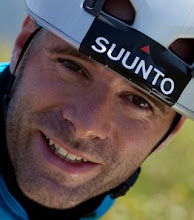
Today I returned to Bessans, deep at the end of the Maurienne Valley for a second crack at an cross country ski marathon. Last year conditions were difficult with several centimetres of fresh snow and temperatures the cold side of minus ten. I struggled round in about three and an half hours - slower than my normal running pace, but satisfied to have completed my first cross country ski race.
This year conditions were completely different. After two huge snowfalls before Christmas the weather in the Northern French Alps has been sunny but cold. Until this week when it changed for the worse: SW'ly winds brought warm, humid air and wind and rain to most resorts. Saturday was as warm as a spring day and the snowpack at all levels has suffered catastrophically. There simply isn't much snow, and what there is below 1800m has been rotted by the rain.
But Bessans is special. Deep in the mountains and surrounded by the glaciers of the Vanoise National Park, it is legendarily cold - as I had discovered in 2009. This year it is one of the few cross country ski resorts in the area that still has reasonable snow cover. Conditions today were warm and the pistes were in fantastic condition. Instead of hacking through fresh snow, it was pure glide on perfect pistes - a potentially record day.
The event is a mass start with both the half- and full-marathon skiers starting side by side. In total well over a thousand people were chomping at the bit at the line and when the gun went they launched themselves forward in a mad folly. Skis were trodden on, there were falls and crashes, and and at least one marathoner's race ended early with a broken pole in the first four hundred metres. I saw him unhappily skiing back to the start, staying to the side of the piste to avoid the swarming mass of skiers.
After the excitement of the start, normally the pace cools off a bit and people settle into a more relaxed marathon rhythm. Not this time. The glide was fantastic and people were enjoying it, hungry to break their own personal records. With so many around it was nigh on impossible to overtake and so I settled into a comfortable pace, pacing myself and knowing that I'd still be fresh for the second half.
For the first 15km the course winds left and right, making a wobbly loop through the fields up the valley from the village. Glancing at my GPS, the first 10km takes only 36 minutes, not bad given the crowds. From there, we descend gently and consistently next to the river. It's a good consistent gradient giving a good cruising speed of over 20km/h. I sneak around one group of skiers and squeeze through another, enjoying the descent and keen to make time. After crossing the river down the valley, we make a U-turn and head back towards the village. Here comes the only extended climb of the course, a perfectly wide and steady slope. The snow is good, I change down two gears, and keep my technique for the climb, occasionally changing stride to give alternative sides of my body a rest.
Cresting the top, I grab a warm sugary tea from an aid station without breaking pace. It's a flat run to the village from here, and the half-marathoners break off left for their finish. I'm in the marathon and I have a second lap to do.
With half the number of skiers and everyone slowly spreading out there's suddenly much, much more space. I'm still fresh and I know the terrain from the first lap. I step up my effort and focus on the skier twenty metres in front of me, hauling in him. Once I'm past him I focus on the next one and haul him in too. And then the next one. The glide is good and despite one wobbly moment while wolfing down a carbohydrate gel, my technique is holding together. This is the best part of the race.
With just 10km to go I glance down at my GPS watch - I've been only going 1h50m. With a quick mental calculation I realise that a sub-2h30m time is possible. Not wanting to waste this opportunity I step up my pace. Once again I'm on the cruising downhill section by the river and I push harder, tucking in behind a group of five skiers. I'm skiing into the increasing wind but that means that the wind will be with me for the long climb. Rounding the corner after the river I again gear down, not wanting to blow up three kilometres before the finish. It works. I crest the top for the second and final time, having gained a few more places on the way up.
On the flat I step up the speed again. The skis are still working well and the finish is in sight. I'll be comfortably under 2h30m, but can I gain any more time? Pushing on and counting down 800m... to go. 600m... At 400m I start my sprint - a somewhat wobbly proposition given my "English" technique - and cross the line at full pelt and 2h23m on the clock, over one hour faster than last year! Yes!
Thanks so much to Sylvain Dhonneur for organising a brilliant weekend and waxing my skis to perfection. This was great training and a real confidence boost for my big cross country ski challenge this year: the 76km Transjurassienne Ultramarathon on Sunday, 13th February. Let's hope there's some snow!
Showing posts with label competition. Show all posts
Showing posts with label competition. Show all posts
Sunday, January 9, 2011
Friday, June 18, 2010
4 days, 24 hours of flying, 580 kilometres XC and 3 kilos of cheese

Pure cross country competitions have been gaining popularity with events like the XC Open and the Czech-organised XCamp. French and PWC Champion Patrick Bérod brought the format to his home site of Méruz at the south end of the Aravis mountains near Annecy in the French Alps in April. I signed up partly for a much-needed break from the day job and partly to get first-hand experience of the XC comp format.
The organisers promised less follow-the-leader gaggle flying, less mindless bar pushing and instead more flexibility, more decision making, and the opportunity to make the most of every day - in contrast to the hanging around and three-hour stress-fest of a traditional comp. I was skeptical. I had concerns about safety (XC comps have a much worse safety record than traditional comps), logistics (how do you organise retrieves when pilots scatter themselves to the four corners of the map?) and fairness (surely the local pilots would have a huge advantage?). As it turned out, I would be wrong on almost all counts.

From the start the atmosphere amongst the competitors was positive. We all realised that the battle would be fought in the air but by sharing information and route ideas we would all benefit. The task was set informally by the pilots: blast down the East faces of the Bauges mountains, do the huge transition into the Chartreuse, bar down to Grenoble to the south, tag a turnpoint somewhere near the Fort St Eynard and then race back north. Big transition back into the Bauges, and then keep going: tag Annecy and then cruise into goal on the valley winds just before the window closed at 17h30. Having launched ten minutes after the first pilot (it was effectively a ground start from a one glider launch) it took me 10km to catch him but conditions were fantastic and once away from launch I made only sixty turns in the first 80km to Grenoble, spending the rest of the time on half bar. I lead out, falling into a natural rhythm with the thermals and the clouds, until about 160km into the task. If it was good I stayed, but as soon as the lift dropped below 2m/s on the 20s averager I put on the bar and glided to the next source. Finally, bizarrely, it was at one of the most reliable thermals in Annecy (the rocks above Bluffy) that I finally fell out of cycle and was caught by Nicola di Bernardo (Mac Magus) and Sylvain Dhonneur (Aircross Usport) who had been chasing hard. After six hours of racing we fumbled our way up to base and headed in different directions to maximise our distances as the final minutes ticked away and goal beckoned. As it was we all made different decisions. Nicola claimed the longest flight but was 130 metres short of the line as goal closed. Similarly for Sylvain. Not getting to goal in time was costly. I'd blasted in with two minutes to spare to take my first 1000-point task win in an FAI Cat 2 competition. Day 1: 180km and 6.5 hours of flying.
Day two was very different. Cloudy. Over-development later. Pilots were tired from destroying their personal bests the day before. An earlier land-by time was set. Despite the tricky conditions this would prove to be the defining task of the competition.
With the forecast of big clouds in the mountains I'd planned a route that took me to the edge of the flying area during the strongest part of the day. The goal was to head towards the flats, clock up the kilometres on the lower ridges away from the main massifs, and then cruise back into Marlens on the valley winds before land-by time. It wasn't easy and I would have bombed out early on had I not been working low slopes with the eventual female winner, Christine Metais (Gin Boomerang 6 X-Alps). But it worked. In a dance of patience and planning I flew from sunny spot to sunny spot, occasionally relying on the magical lift-sniffing abilities of my Axis Mercury 08, and sometimes counting only on its raw speed and stability when jumping from mountain to mountain. Christine doubled back at the Montagne de Banges but I continued. The game was sunshine and shadow. Working large-scale weak lift I got rained on and hailed on, but it was only light. I flew into goal with just over five hours on the clock and a slow 105km on the counter. An insignificant distance compared to the previous day but hard-fought and enough to hand me my second 1000-point task win. Day two: 105km, 5.5 hours.

The Meet Director Patrick Bérod announced that Thursday would be the last day. The accumulation of twenty hours flying in the best conditions that the French Alps have to offer was beginning to show in the eyes of the competitors. Of course, it's never easy. The beloved French President Sarko was in the area and this meant that there was an air exclusion zone around our normal playground of the Bauges until 13h30. We headed further away to take off - the ski resort of les Saises with it's south-facing slopes at 2000m - but it was still a game to make the most of the day.
Flush from three days of success, I got it horribly wrong. In my mind the goal was simple: don't take any risks, fly well enough to score 600 points which given my 400-point lead over second place Julien Senzier would be sufficient to secure the competition win. Even with this, we discussed tactics beforehand, freely sharing our information. But this day would not be mine. In the air, sensing a weakening of conditions, I took the conservative option of flying in the Bornes and Aravis mountains with a guaranteed return to goal in the Annecy valley. I got trapped under an inversion. Twice. On a weak day that would also be worth 1000 points like the others, in a four hour task I spent two hours scratching, going nowhere. I limped into goal, a few km under the belt but doubtful whether it would be enough.
While I had been stuck surviving, Kiwi Glen had been blasting up and down the East faces of the Bauges as fast as his Niviuk Peak would take him. Not bad for a non-local pilot who'd just learned the entire area in three days flat. While I'd done a mere 80km in four hours he'd clocked up 120km in the same amount of time but had been agonisingly a couple of kilometres short of goal when the time ran out. Nicola di Bernardo had got it right. He'd flown at speed-to-fly and blasted into goal a little early due to confusion about the land-by time. Having won three days in succession, was I about to lose it all?
On that final day I was 18th out of thirty. Everybody else was celebrating finally beating me. I was gutted that I'd fallen short, failing at the last hurdle. In those tense few hours before the final results came out I was not a good person to be around. My mood had changed from loving the flying and the atmosphere to playing zero-sum games of your win is my loss. It was not a proud moment.
Friday dawned cloudy and inverted. There would be no task. Despite my errors the previous day I had kept my first place albeit giving away two hundred points to second-placed Julien. I topped off the week by landing on the spot in the local stadium in Ugine to thank the local commune for letting us use the launch and adding a kilo of mature Tomme cheese to my pile of delicious Reblochons from three task wins and my first FAI Cat 2 win.
So, how were the logistics? Pretty good. The retrieve was organised using a minibus in each area. I got back to goal each day in time so didn't get to test out the retrieve system myself, but no-one was late back and everybody was happy. Safety? There was one reserve deployment with no injury, which given the 1000 hours of flying in strong Alpine conditions accumulated by the pilots was about par for the course. The emphasis on personal decision making meant that each pilot made his/her own individual decision to fly or land rather than being told what to do. Fairness? Well, the jury's still out on this one. I knew the area well and did well, but Kiwi Glen arrived with no local knowledge and nearly won the last day. As a non-local pilot you're unlikely to win but you'll certainly walk away having learned a fantastic amount.
Rumours are that they'll be another Cat's Cradle at St Jean de Montclar (site of the 2009 British Open) towards the end of the summer, and maybe a wider series to follow. See you there?
Full results.

Wednesday, August 12, 2009
The X-Alps: The Inside Story
 Judith Mole and I have just done the follow-up podcast on the race and it's aftermath. Have a listen to it on Judith Mole's paragliding podcast page.
The race was very tough but I was very happy to still be in the race at its end. The podcast covers a lot of topics, but if I've missed anything then email me at twpayne at gmail dot com and I'll answer your questions here.
Photo credit: ©Vitek Ludvik / Red Bull Photofiles
Sunday, June 14, 2009
Three good days in Annecy
 It's been a pretty windy Spring in the French Alps, but a ridge of high pressure built over the France and the Western Alps over the weekend and I took a half day of holiday from work on Friday to take advantage of it.
On Friday I took off with my friend and fellow Axis pilot Damien de Baenst from the Planfait take off. It's my favourite site. It's relatively low (900m) but the aerology is fantastic, meaning that as you climb up to the Dents de Lanfon you look down on take off. It's a real escape. The other main Annecy take off - Col de la Forclaz - is higher, and is a better choice in some weather conditions, but you don't get the same sense of "climbing out" as you do from Planfait.
From the Dents de Lanfon (usually called "the Teeth") we headed north to Parmelan where great 3m/s climbs catapulted us up to over 2000m. The air was exceptionally clear that day, and it felt like you could reach out and touch Mont Blanc, over 50km away to the West.
We headed back to the Teeth and then crossed over the lake to the Roc des Boeufs. Anyone who has flown in Annecy will know that these are classic flying routes. Here it took some time to find a way through the inversion at 1600m, but we both eventually made it through and headed for Margeriaz. I arrived somewhat ahead but found that the north tip of the ridge was only working weakly, so I continued round to the west face. Which was dead. Not a single peep from the vario. Now without enough altitude to get back to the north side, and stuck in the stability, it was suddenly all over and I was left with just enough time to chose a landing field. I radioed back to Damien to warn him and he was able to stay on the north side and continue his flight, eventually landing at the entrance of the Maurienne valley.
At this point I cheated. It was late in the day and there was no time to walk up to another take off, so I stuck my thumb out. Anyone who's landed in the Bauges mountains knows that there is very little traffic and getting home can take a long time. However, I was lucky, and after just 20 minutes a young guy stopped. His beaten up Peugeot 205 barely held together, no doubt shaken apart by the thumping hardcore techno music he was playing. The tempo of the music was matched only by the speed of his driving (and he was a local who knew the roads). It was great fun (and I loved the music), he kindly dropped me off at the Revard (4 Vallees) take off, and just one hour after having landed I was back in the air again.
Here the goal was clear: get back to Annecy. It was late in the day but I knew the route. The stability was still there, but my Axis Mercury climbs and glides amazingly so, despite being a lot lower than I would have wanted for several of the transitions, I was still able to make it back. In the landing field I met fellow first-time X-Alps competitor Ronny Geijsen who was in Annecy to test his newly-arrived wing and fly in the PWC. There's no book about how to prepare for the X-Alps, so we eagerly swapped notes about gear, training and strategy. He's also a thoroughly nice chap.
On Saturday I headed, again with Damien, to a new take off for us both at the south end of the Aravis mountains. Not much more than a small clearing in a forest with magically fewer line-snagging rocks than your average mountains side, it was a real discovery. We launched, once again, in to stable air on the wild, steep SE face of Mont Chavin.
It took an age to climb out. Every metre was hard won in the 0.3m/s thermals, and ten minutes work would every now and then be wiped out by a few seconds of -3m/s sink. It was galling. After several attempts to break through the inversion at 1800m I gave up and decided to do something different. With another Mercury (not Damien) and two DHV 2s headed West over the classic site of Marlens and on to the SE faces of Tournette. This was a flight that I had heard was possible, but I'd never tried before. On this day, with the stability, I fully expected to land early.
But somehow, despite the weak and broken thermals, we were able to soar up in the slope breeze and finally broke through to more unstable air above. To get through an inversion on a paraglider you've generally got two options: either find a large and strong enough thermal that's powerful enough to break through to the air above, or tuck in tight to the terrain, kick trees, and work the slope breeze. Today, only the second option was possible. But it worked! The slope breeze gave way to reasonable thermals and eventually we popped through in to steady 3m/s climbs up to cloud base now at 2500m.
This was a new route for me, and I remembered Aidan Toase's advice for the X-Alps: "You have to be happy flying alone over unknown terrain", so I resolved to explore as much as I could on this flight. I flew straight past Annecy, not bothering to turn in a thermal full of competition pilots preparing for the Paragliding World Cup. Alone at Parmelan, I found an incredible 4m/s thermal that launched me in to orbit and used this to head north.
Despite having lived in the area for several years, I had never flown these mountains before. Sous Dine, Sur Cou and the Pointe d'Andey came up and I cruised past them. My only knowledge of this area came from driving to the ski resorts of La Clusaz and Grand Bornand, and my memories consisted mainly of narrow tree-lined valleys with no landing options.
Several pilots have remarked on Alex Hofer's flying attitude: he flies with total confidence. There's no need to worry about having nowhere to land if you're not going to land. If there have been thermals in all the south-facing bowls so far, then so will the next one, even if it doesn't have a big grassy field to land in at the bottom. So, I adopted a new mental tactic. At each decision point, I asked myself: "what would Alex Hofer do?".
It's scary at first, but it works. I chose a remote col where there should have been convergence between the southerly thermal breeze and the northerly meteo wind, and indeed it worked. Elsewhere I flew into a high a tree-lined bowl and it worked as well. When you're high there are landing options that you can't see from the ground: the glide angle of your paraglider means that you have a large search radius, and you only need one decent field in that area to be safe. But you shouldn't worry about the details of identifying an actual landing field. Instead, I think the trick is to focus not on what happens if you don't find any lift, but rather the focus on where the lift actually is.
Finally I ended up flushed through some sink and too low in the low level stability to get up again and landed out. Five quick and easy hitches with several interesting people got me back to the valley below my car, but I knew (and had planned) to walk up from the valley floor to where my car was.
1000m height gain, 15km along the road, all with 25kg (40% of my body weight) of competition wing and harness on my back took just under three hours, fuelled only by a bit of leftover couscous and half a litre of energy drink. It was a good slog and almost dark when I got to the top. Incidentally, the road has 41 hairpin corners. It's reassuring that I can do it, and the only damage was a small blister on one toe because I was stupidly wearing normal cotton socks. It'll be a lot easier with Alex supporting me: proper nutrition, moral and tactical support, and a change of socks and shoes every now and then.
Sunday was the first day of the Paragliding World Cup. It's a long-term personal goal to compete in the PWC. I went along to the competition to catch up with friends there and to meet several of the X-Alps competitors. Watch out for the British Force of Mark Hayman, Jamie Messenger and Craig Morgan. Of this year's X-Alps athletes, five are there: Toma Coconea, Vincent Sprungli, Primoz Susa, Ronny Geijsen and Helmut Eichholzer. It was great to finally meet the legend that is Toma Coconea and his supported Gigi. Toma, the poor fellow, wanted to run up to take off but had been told that he had to take the bus! My friend and 2007 X-Alps competitor Ulric Jessop was also there and it wad great to catch up with him and get loads of tips gear and tactics.
I had the privilege of wind dummying for the competition, taking off just before window open to find out if anything, anywhere was going up. Luckily for me, the inversion at 1260m was just begining to break as the competitors launched, and I got a bird's eye view by parking myself over the middle of the course and watching the race. I've got to say, these PWC guys (and gals) are really fast. It's a great ambience on the ground, but once in the air everyone is focused on maximising every thermal and pushing as much bar as possible on every glide.
Flying competitions is definitely a different set of skills to the cross country which I've been focusing on. In fast and full-on competition you have a defined task, you're flying during the strongest part of the day, and you have the world's fastest pilots around you to help you find lift. Flying XC, typically on your own or in a small group, flying all day long, and adapting your route to the terrain and the changing weather conditions is another set of skills. It's a real sign of maturity in the sport that paragliding has now evolved in so many different directions.
Alex arrives in Geneva on Wednesday for the final month of preparation. The race start feels awfully close now.
Sunday, May 17, 2009
Wing arrives, Swiss League Cup
 My X-Alps wing arrived on Friday! Thank you Axis UK! She's a beauty: 6.3:1 flat aspect ratio and racing trim giving her accessible comp wing performance and weighing just 4.8kg.
No simple top-to-bottom to get to know her, instead I took her to Frutigen near Interlaken in Switzerland for a round of the Swiss League Cup. For me it was an opportunity to discover a new flying area, get to know the wing, try out the X-Bus and meet a few of the big names in Swiss paragliding.
 Saturday, day 1. Conditions were expected to be tricky and indeed they were! Although the airmass was unstable, rising atmospheric pressure restricted their upward movement. The result was small, weak, snotty thermals that seemed to form randomly and then peter out after a few turns. You'd occasionally hit a 2m/s thermal, but most of your time was spent grovelling over the trees in 0.2m/s. The Task Committee set a 49km task around the local area. Most of the field, including me, bombed out at around 20km, simply running out of options at the third turnpoint, but a few pilots persevered. PWC Champion Anja Kroll won the day, getting to goal in 3h20m and 35 minutes ahead of the only other pilot to complete the course.
 I was really happy with the wing. I was flying in my normal cocoon harness which put me 5kg over the top of the weight range and yet I was still able to climb well. The air was turbulent behind the spurs in the lee of the valley wind and yet on a day when two wings ended up in the trees I had nothing more than a tip collapse.
 On Saturday night I got to test the X-Bus, my first night in the support vehicle. It's brilliant! Comfortable, plenty of space to stand up and cook inside, light, heating, music, and a warm night spent in my down sleeping bag. It's a home away from home.
Sunday was forecast to be marginal: sunny in the morning but with Foehn winds in the Valais and moderately strong SW'ly winds at altitude. Fellow X-Alps competitor Chrigel Maurer was here today (he lives just down the road) and I was eager to find out more about his preparations. He's designed his own wing and sewn his own harness: the combination is very compact and weighs only 10kg. As we arrived a take off the race committee realised that with the strong winds it wasn't going to be taskable and made a quick and correct decision to can the day so we could get a short free flight before conditions got too bad.
 Many launched quickly (although a few decided to take the bus down) and those who did fly were rewarded with a stunningly beautiful flight. The weak thermals of yesterday had been replaced with solid two and three metre per second climbs. I took one to over three thousand metres and with stunning views in all directions, including the lakes of Interlaken and the unmistakeable 4000m trio of the Eiger, Monch and Jungfrau peaks, one of the turnpoints in the 2007 race: see the photo at the top of the post.
The forecast was spot on, however, and with a Foehn wall visible tumbling over the cols between the peaks, a brisk 30km/h wind at 3000m, lenticular clouds forming, and a forecast of storms in the afternoon it wasn't a day to hang around so I spiralled down to land back at base.
It was a real pleasure to meet Anja Kroll, Joerg Ewald, and Swiss paragliding guru Martin Scheel. The organisation by the local school Cloud 7 paragliding was excellent, and thanks to all of the pilots who made me feel so welcome. While I was walking back on Saturday a car full of pilots spontaneously stopped for me and I had to explain that, in fact, I didn't want a lift and actually wanted to walk back...
Update: Martin Scheel's beautiful photos of the event are now online at his site www.azoom.ch.
Subscribe to:
Posts (Atom)