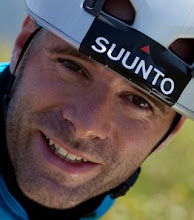
It was a good day. The forecast was slightly dubious: all week they had been saying that it would be more humid on Sunday and would storm. Secretly, I was quite looking forward to a day off. However, Laurence Stein was keeping a close eye on the weather and called us over for a 11am start from Chamonix when the forecast suddenly looked much, much better on Saturday night. The stated goal was out-and-return to Annecy.
 Quentin King, Laurence and I arrived at take-off as the wind was deliberating between the two sides. A fast run eventually got me launched, straight into a 3m/s thermal marked by several pilots in the air. Leaving the Brevant at a shade under 3000m, the glide across and climb up to the Rochers de Fiz was straightforward. There was no visible inversion in the valley below which was a good sign, the only question was whether it would storm later in the day.
Flying across to the Aiguille de Varan, the lift always seemed to be where I wasn't. Finally I managed to climb up to 2700m, still a hundred metres from base and 400m below where I wanted to be. However, I decided that this was as good as I was going to get and so set off for the Quatre Tetes on the end of the Aravis. The slight sink was compensated for by a gentle tailwind and I arrived on the SE-facing slopes at about 1650m. It was a long slow, struggle to gain altitiude in the weak slope breeze, but finally I got enough height to soar around to the S side where a reasonable but rough thermal took me above the peak. Another couple of turns before Point Percée set me up to glide down the Aravis.
 Or so I thought. The hanging valley below was still full of snow but the cliffs above were clear and I assumed they would be working. I was wrong. I flew along the cliffs, finding nothing, and I when I arrived at the snow line I knew it was all over and it was going to be a long walk out. Turning tail I flew low over the snow fields and just escaped the valley where I blundered into a solid 4m/s climb that took me back to the height of Point Percée. Laurence and Quentin, having taken off fifteen minutes after me, had now overtaken me and were gliding along the Aravis so I toped up until I lost the climb and chased after them, leaving 200m higher this time and detemined not to make the same mistake again.
But I got it wrong again. There was nothing, even above the cliffs. Quickly I had to decide whether to try to make it over the next col and around the corner or turn around again. It was touch-and-go but, figuring that the day was already over with the time I had wasted, decided to go for it. Flying through the col with literally three metres to spare I expected to be greeted by S-facing scree slopes and an easy climb. But no, it was another snow-filled bowl! Quentin and Laurence were climbing weakly on the cliffs ahead and above me, but for me all was lost. I glided around the bowl, just one metre off the snow, not expecting anything and not finding anything. Suddenly, I spotted a white glider climbing out from the bottom of the bowl and I headed over to be greated by a weak, broken, ratty thermal but it was my only ticket out of the back of beyond so I hung on.
Finally climbing above the tops I popped out a couple of k behind Laurence and Quentin and, despite the rough, lifty air above the Aravis I could finally breathe a sigh of relief and focus on the next stage.
 From here on the flying got a lot easier. Good climbs on the Etale, Charvin and Sulens got the three of us to Tournette above Annecy at 2pm. We looked down onto the lake to see people starting to climb out Planfait and Forclaz, and yet we had already flown all the way from Chamonix! A bit of radio chatter revealed an uncertainty as to whether it was in fact too early for Roc de Boeufs. However, we were high, the day was looking classic, and there was already a good breeze on the lake so we went for it.
The Roc was working, but it wasn't easy. Taking one climb and thinking it was in the bag, I headed for the peak for what I expected to be a rocket launch to the forming cloud above. It wasn't working. I got stuck short of the second electricity line and got battered in the rough air. I couldn't find anything solid enough to turn in and so fled back North. Laurence had a similar experience and had to fly back the full length of the mountain to get back up again. Quentin had climbed out with ease, earlier.
 Finally getting above the peak I was suddenly on my own. Laurence was now a long way behind, Quentin's radio was now dead and I didn't know where he was. It was time to start back to Chamonix but which way? Back across Annecy or south fo the Dent d'Arclusaz?
I'd flown the Dent d'Arclusaz a few times in the past week and there was a good (almost too good cloud above it). Looking to my left I saw Marlens, Charvin and the Aravis chain stretching towards Mont Blanc and Chamonix in the distance. I knew the long route home and I believed it possible.
 Now on my own, 70km from home and seeing the now epic sky it was time to race. Full bar and a tailwind whisked me to the Dent d'Arclusaz with only a few turns in a stonking 6m/s climb at the Dent de Pleuven. There I was joined by a blue Sigma 6 who Laurence had told me was in fact Lucas Bernadin from Chamonix. We raced each other to base in 5m/s climbs at the Dent d'Arclusaz and then headed different ways back. Lucas crossed to a big cloud in the middle of the Bauges whereas I took my traditional line along the Albertville valley.
In the distance I saw a red and yellow Airwave glider scraping the clouds and thought it might be Quentin. I raced on, taking good climbs and gliding on the bar. I wasn't quite as high as I would have liked for the long transition to Marlens, but had always had a tailwind here and knew that Marlens worked from very low down. Arriving just a couple of hundred metres behind Quentin we were both delighted to see each other and whooped our way up in the slope breeze and thermals to base above Charvin. It was 40km to Chamonix and it still looked achievable. But it wasn't going to be easy. A storm had brewed and was dumping rain on the north end of the Aravis. Over our route home there was a large but not too tall cloud shading the entire Megeve valley. It was going to be close.
 Lucas had set of first and I waited for Quentin at base before heading off together. Not sure where to aim for we saw that Lucas had a climb and we joined below him. However, it soon petered out after a few turns and we headed off to the last bit of sun on the Megeve airport, instincitively spreading out 100m apart to search for lift. Finally we found it, and we climbed together in a smooth but weak 1m/s. Suddenly I felt a few spots of water and realised that it was raining on us! We continued climbing together and as we rose the rain turned slowly to light hail. Immediately to our west a huge twisting funnel of rain was dumping on Megeve itself. The sun illuminated it from behind and it was truly stunning to behold.
Toping out just below cloudbase we set off on glide over the shaded valley, still in light rain, aiming for the sunny slopes of Mont Joly in the distance. We just made it, connecting with the slope breeze which released into a nice thermal. Chamonix was now in the bag and the three of us set off, Lucas leading the way.
 We crossed the col into Chamonix valley into rough air over Les Houches. After a sinky couple of minutes over the broken mountainside above Les Houches I finally connected with a decent climb and Quentin came to join me. Together the climb took us from 2200m to cloudbase now at 3750m. This was simply beyond words. Incredible vistas across the slopes of Mont Blanc opened up as we climbed. Wisps of cloud and huge seracs clung to its flanks. The pure white snow, perfect red granite and deep blue sky made this simply one of the most amazing moments I have experienced in a paraglider.
 We left the cloud at base and I looked over my should to see Quentin heading straight for the Aiguille du Midi! There was a small cloud near the peak so I headed over to join him. We soared amongst the stone pinnacles in the pink evening light, climbing above the Cosmiques hut and waving at the climbers relaxing on the balcony. Quentin climbed higher, working the lift to finally top out over the top the Aiguille du Midi itself. Seen from the air it is incredible: a modern fairytale castle built in the sky. Buildings clinging precariously to the impossible rock spires, between which arc soaring bridges. For a few moments we felt like birds, incredibly privileged to be here, now, at the one moment that it was possible.
I had now been flying for over seven hours, but wasn't quite finished yet. My final objective was the Drus and the Aiguille Verte so I headed along the Chamonix Aiguilles, almost overwhelmed by the mountain splendor. I looked down on the Vallee Blanche and to the imposing north face of the Grand Jorasses beyond, with the mighty Dent du Geant perched on its southern end. Behind me the clouds built around the Aiguille du Midi, finally closing the door on that magic moment.
Finding a climb on a spur below the Grand Montets I thermalled up, over the lift station under the watchful eye of the Aiguille Verte and the Drus next to me. Drifting over the cable car and still climbing, I decided that I and the flight were complete, and glided into the valley to land.
All photos taken by Quentin King, see the full set at http://qking.web.cern.ch/qking/2007/p_chamonix/. You can download my GPS tracklog from Leonardo.
Wave is fairly common in the Welsh Borders in the UK where I used to live, and I've flown gentle wave in my paraglider several times.
But this is a different story.
I met real mountain wave in my paraglider a few of weekends ago, in Saas-Fee in the Swiss Alps. It was the closest I have come to a fatal accident in a paraglider.
A friend and I had gone to do a bit of early season glacier skiing and had thrown our gliders in the back of the car on the off chance of flyable weather. On the Sunday the lift queues were interminable and the skies were blue so we decided to fly down from the top station (3500m) to the village (1900m). Jon was flying his Baby Boomer with his normal kit and I was flying my Aspen with my lightweight harness (no reserve). There was only one cloud in the sky, a distant cumulus over the Bernese Oberland which looked a little rounded and could have been a lenticular but in our valley everything looked fine so we disregarded it.
The take off on snow was uneventful, with a gentle cross wind but nothing too tricky. Jon lobbed off first and I followed a few moments later. There didn't seem to be enough wind to soar the upper ridges near the lift station, but secretly I hoped for a gentle thermal on the far, sunny slopes above the village. However, the atmosphere felt very stable so I resigned myself to a spectacular top-to-bottom flight over the dry glacier and scree slopes leading down to the resort.
Jon was a few hundred metres ahead of me, just flying over the headwall of the glacier when he hit lift. "Wa-hey," I thought, "we can soar!". But Jon kept accelerating upward while flying straight, climbing so quickly now relative to me that I looked down at my vario thinking that it must be me in driller sink but my sink rate was normal. Still without turning, I saw Jon fold in big ears, now climbing upwards and backwards. "Oh shit," I said, "this is going to be interesting." Anticipating the strong lift I struggled to push my speed bar, but I couldn't get it to grip against my slippery plastic ski boots. Ready on the brakes, I flew over the glacier headwall and prepared myself to be catapulted into orbit.
But I didn't hit lift. I hit rotor. Pure, evil, mountain wave rotor. The glider thrashed above me and I immediately knew I was in a very bad place. The left wing collapsed 30%, then, before it could recover, the right wing collapsed 40%, then the left wing collapsed further. I fought to control the wing, but this wasn't the localised turbulence that you find on the edge of a thermal. I was in a washing machine, about to be chewed up and spat out as a tangled mess of wing, line, and pilot. The wing surged, dived, re-opened, twisted and span. I looked from my harness to the wing and saw a full riser twist and the wing at the horizon, the glacier beyond. Over the deep crevasses and exposed broken rock, cliffs and scree slopes there was to be no survivable landing, not even under a reserve parachute, which I didn't have anyway. My single thought was quite clear: "This is serious."
With no recourse but to fix the wing before I ran out of altitude I focused on the task at hand. There was only a single twist in the risers and I found the brakes still worked. The increased airspeed and wing loading of the spin had re-opened the glider so I steered it out as if I was coming out of a spiral dive, against the twists so that they unwound as I exited the spiral. The final half turn flipped me round as the wing came overhead. Without hesitation I reached up for the big ears and somehow managed to push the speed bar despite my plastic ski boots.
The wing continued to thrash, roll and collapse with the ears in, but the increased wing loading of big ears and bar kept it above my head. With suddenly a moment to spare I looked around to see what had happened to Jon. He was below me, near the upper middle ski station. Finding himself going upwards, backwards and being blown into Italy in strong mountain winds he had rapidly assessed his options: he wasn't going to make progress against the wind, with big ears in he'd still end up behind the knife-edge alpine ridges, a reserve would have brought him down in the next valley in rotor. The only option was to escape the lift before he got blown back. So he spiraled for his life. A full-on, nose-down spiral that got him down and out. He didn't stop until he was close to the ground and well away from the awful wave.
Together we limped towards the resort and the beckoning safety of the golf course landing field. My wing, with ears and speed bar, continued to collapse but it seemed somehow trivial compared with what I had experienced in the twisted spin. Jon was doing a better job of managing his wing, and eventually we spiraled down to touch down within a few metres of each other on one of the greens in light, pleasant winds.
Somehow the world of the mountain wave seemed far away as we lay in the warm grass cursing our stupidity and feeling lucky to be alive. We stared back up towards the glacier: of course, you couldn't see the boiling pot of turbulence at the glacial headwall. It was strange to have such a close brush with death and yet emerge unscathed. Above us the wave bars were now clearly visible and rotor cloud foamed from the peaks around us.
With a scream of "Ataka!" my skis leave the ground and I plunge down the slope. Skimming the tops of the bumps I pull on the brakes in search of a glide angle and I fly over the piste. As it flattens out my skis touch down in the powder, leaving tracks in the snow that come from nowhere. Raising my hands to pick up speed, I carve deep in, the wing just tugging gently from above, eliminating any fear of loss of control. Exposed rocks ahead mark where the slope falls away again, and I accelerate towards them, daring them to shred my skis. At the last moment I pull the brakes and convert my speed into altitude and sail, laughing, over the top. Below me, the slope is rocky and rough so, grinning, I raise my hands. The wing immediately picks up speed and dives downslope, and I go with it, dodging the piste markers while bemused skiers interrupt their struggle to stare upwards. Here the mountain is steep and even at this speed I cannot stay close to it. I pull on the left brake and the wing and I dive together into a steep turn, burning altitude like a meteorite. I traverse back over the piste with feet to spare and turn right to align myself with it. Flexing my knees, I begin my flare early but I still touch down at 50km/h, turning the wing into a kite to pull me to the chairlift and another go!
If you hadn't already guessed, I went Speed Riding for the first time today. It's as much fun as it looks, and not even half as difficult.
In my mind, I had planned a long technical article explaining in excruiating detail every aspect of the day, but that's not what the sport is about. Instead, here are a few bits of information.
The wings are small free-fall parachutes, with some small modifications. Long brake travel, very inefficient (especially in turns), very quick, super solid, and very easy to fly. Take off is probably the trickiest bit until you get the hang of it, but by the end of the first day you'll just be chucking your wing upslope, inflating and launching the wing from a bag of washing with the front and rear risers, and then skiing off. The better you are, the smaller the wing you fly, and the faster you go! Landing is easy, then you just bunch up the wing and get straight on the chairlift. On my first day today I did twenty flights and the good guys tell me that you can do forty if you're keen.
As far as crossover from other sports go, surprisingly skiing is probably a bit more helpful than paragliding. This is because you're spending the day on snow, and occasionally skiing down steep stuff to take off. Skiing gives you a familiarity with this situation that frees you to focus on the flying, whereas non-skiers might be overwhelmed by the winter mountain environment. Having said that, anyone who flies a paraglider or a kite will very quickly (read: one or two flights) pick up launching and flying. Paraglider pilots will have the advantage judging landings, once they get used to knocking five points off the usual glide ratio!
A word has to be said about the required weather conditions. In the video it's blue skies and forward launches in no wind. On my first day today it was blowing 40km/h on launch *and snowing*! And we flew in light rotor. But it didn't matter at all. Collapses are virtually unknown (strong turbulence just increases your sink rate) and forward speed is rarely a problem. If you imagine the wind strength in the high mountains required for an eight square metre wing to soar, then you'll have an idea of the upper limit on conditions. This is not a sport that does its laundry on windy days (although, afterwards, you might have to do yours).
What does the sport offer? Well, it's pure descent, pure fun. No stress trying to stay up in weak conditions (it's impossible in all conditions), no fear of collapses (flying in the lee? it doesn't matter and you won't care). Brief, intense experiences shared with friends, and a vin chaud at the end of the day. Perhaps Hans describes it best: "C'est du Playstation!"
Thanks to Franck Coupat, Hans Prunaretty and David Eyraud for a wonderfully warm welcome and a brilliant day! I'll be back with the Northerly wind to Atak the couloirs...
 Quentin King, Laurence and I arrived at take-off as the wind was deliberating between the two sides. A fast run eventually got me launched, straight into a 3m/s thermal marked by several pilots in the air. Leaving the Brevant at a shade under 3000m, the glide across and climb up to the Rochers de Fiz was straightforward. There was no visible inversion in the valley below which was a good sign, the only question was whether it would storm later in the day.
 Or so I thought. The hanging valley below was still full of snow but the cliffs above were clear and I assumed they would be working. I was wrong. I flew along the cliffs, finding nothing, and I when I arrived at the snow line I knew it was all over and it was going to be a long walk out. Turning tail I flew low over the snow fields and just escaped the valley where I blundered into a solid 4m/s climb that took me back to the height of Point Percée. Laurence and Quentin, having taken off fifteen minutes after me, had now overtaken me and were gliding along the Aravis so I toped up until I lost the climb and chased after them, leaving 200m higher this time and detemined not to make the same mistake again.
 From here on the flying got a lot easier. Good climbs on the Etale, Charvin and Sulens got the three of us to Tournette above Annecy at 2pm. We looked down onto the lake to see people starting to climb out Planfait and Forclaz, and yet we had already flown all the way from Chamonix! A bit of radio chatter revealed an uncertainty as to whether it was in fact too early for Roc de Boeufs. However, we were high, the day was looking classic, and there was already a good breeze on the lake so we went for it.
 Finally getting above the peak I was suddenly on my own. Laurence was now a long way behind, Quentin's radio was now dead and I didn't know where he was. It was time to start back to Chamonix but which way? Back across Annecy or south fo the Dent d'Arclusaz?
 Now on my own, 70km from home and seeing the now epic sky it was time to race. Full bar and a tailwind whisked me to the Dent d'Arclusaz with only a few turns in a stonking 6m/s climb at the Dent de Pleuven. There I was joined by a blue Sigma 6 who Laurence had told me was in fact Lucas Bernadin from Chamonix. We raced each other to base in 5m/s climbs at the Dent d'Arclusaz and then headed different ways back. Lucas crossed to a big cloud in the middle of the Bauges whereas I took my traditional line along the Albertville valley.
 Lucas had set of first and I waited for Quentin at base before heading off together. Not sure where to aim for we saw that Lucas had a climb and we joined below him. However, it soon petered out after a few turns and we headed off to the last bit of sun on the Megeve airport, instincitively spreading out 100m apart to search for lift. Finally we found it, and we climbed together in a smooth but weak 1m/s. Suddenly I felt a few spots of water and realised that it was raining on us! We continued climbing together and as we rose the rain turned slowly to light hail. Immediately to our west a huge twisting funnel of rain was dumping on Megeve itself. The sun illuminated it from behind and it was truly stunning to behold.
 We crossed the col into Chamonix valley into rough air over Les Houches. After a sinky couple of minutes over the broken mountainside above Les Houches I finally connected with a decent climb and Quentin came to join me. Together the climb took us from 2200m to cloudbase now at 3750m. This was simply beyond words. Incredible vistas across the slopes of Mont Blanc opened up as we climbed. Wisps of cloud and huge seracs clung to its flanks. The pure white snow, perfect red granite and deep blue sky made this simply one of the most amazing moments I have experienced in a paraglider.
 We left the cloud at base and I looked over my should to see Quentin heading straight for the Aiguille du Midi! There was a small cloud near the peak so I headed over to join him. We soared amongst the stone pinnacles in the pink evening light, climbing above the Cosmiques hut and waving at the climbers relaxing on the balcony. Quentin climbed higher, working the lift to finally top out over the top the Aiguille du Midi itself. Seen from the air it is incredible: a modern fairytale castle built in the sky. Buildings clinging precariously to the impossible rock spires, between which arc soaring bridges. For a few moments we felt like birds, incredibly privileged to be here, now, at the one moment that it was possible.